
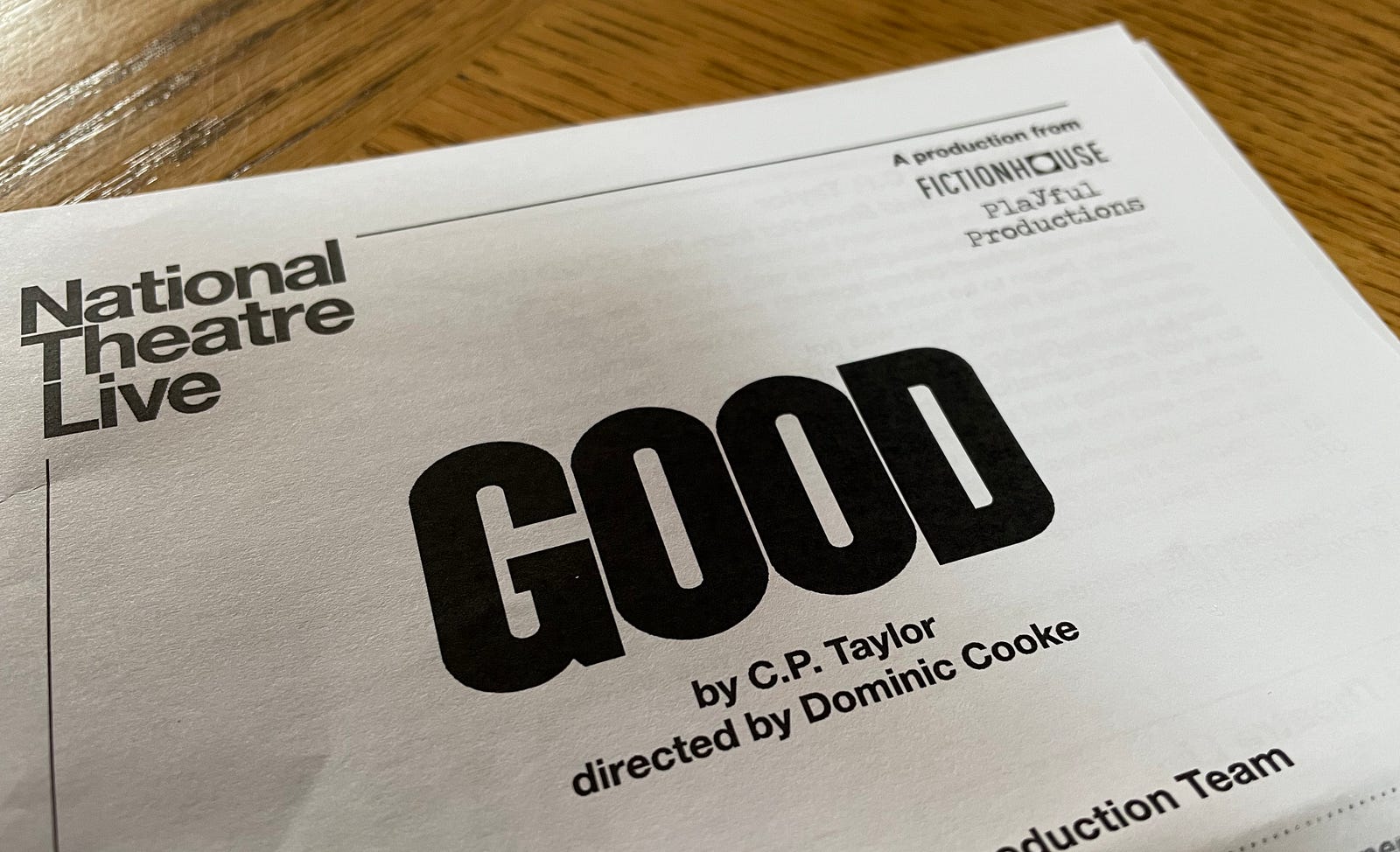
A review of "Good" by C.P. Taylor and the National Theatre Live
What does a frog think as the water boils? Will the water go green? No, the water bubbles and bubbles more! Told all its life that green is not good — but green felt natural, provided community, friends, croaking at night and meetings in the long grass at dawn. They said a bath would clean the green. Now the bubbling, and its hard to stay awake, alive.
Last night, in westest Wales, I watched the National Theatre Live streamed into an auditorium filled with a countryside audience. We watched C.P. Taylor's "Good". It winded. We all knew the story — of a good man, a happy man — whittled away by pride, lust and power, until he stood, a Nazi commandant, at Auschwitz. It was not bad to retell the story of the holocaust. It should be a-historical, set above history, to warn of our ability to be bad without caring. Like the Milgram's experiments, this was a exposition of power — the power of a white coat or jack boots. We move with the crowd while our narratives reform our thoughts to justify the seemingly impossible. In "Good" the main character complains that the fate of his friend is lower down his list of worries than losing his partner to another — and yet he left his wife to his new partner that he fears losing. If he could not see the irony of that, how could he see machine gun bullets heading for his best — only — friend?
I would recommend that you stream the play yourself, but it was being with others… yes, the crime of it all. Being with others, was that the crime? We all sat there and drank the kool-aid. But it is not kool-aid. Wanting others to be able to live their lives while we live ours. (Why did I go plural?) Wanting to live my life, safe in the knowledge that others are living theirs. Better. You see the title "Good", did not help say what was good. Was he a "Good" man? Was it a "Good" play? A free floating signifier, the meaning never attached, demands that we try to bring it into connection with some, many, any things.
David Tennant was crafted as he chipped away at his character's neuroses. First fell his ability to listen, followed by his ability to see danger. He allowed a kiss to end his marriage. He sought the smells of the forest and Candide's garden to hide and grow. Oh, it can't last — as he burnt books and excused brutality as the aberrations of a new society's childhood, a child in a playroom splattered in blood and carpeted in broken glass, Enid Blyton pages curling in flames. The glimpse of his character's lecture at a college, about how jewish individualism stood in contrast to the social, national, cultural collective future was most chilling. It is not that we do not live in a society — it is that society is capable of crushing us without thought, consequence or even knowing — that we stand in a competition of forces to protect us. As Robert Bolt had More tell Roper in 'A Man for All Seasons':
This country's planted thick with laws from coast to coast-man's laws, not God's-and if you cut them down-and you're just the man to do it-d'you really think you could stand upright in the winds that would blow then? (Quietly) Yes, I'd give the Devil benefit of law, for my own safety's sake.
— A Man for All Seasons
But his two fellow actors, Elliot Levey and Sharon Small, were brilliant. Instead of scene changes: lighting, talking aside and to the audience, a change in voice, posture, accent, volume — all enable the three to be others or indicate a change of time and place. The set was a metre, and provided the the teedum or teedee of marching the halls of the facist machinery building a new society. Hatches opened and books poured into the set. The books were hefted through another hatch to the flames of insidious censorship.
And he used the word "banal" as a nod to Hanna Arendt. This play was written in 1980, long after "The Origins of Totalitarianism" or "Eichmann in Jerusalem". I was privileged to study "Utopia and Its Critics" under Peter Skiff at Bard College in 1979. He had us read More, Arendt, Milgram and so many others. He enjoyed teaching students of the 60's who would demand he teach their way. We students of the 80's were a disappointment, I feel. When I arrived at Bard, students sat in circles on the lawn before the administration building smoking weed. When I left, Reagan's yuppies were arriving, seeking an education for a job and a better income. Skiff wanted to be Aristotle and I wanted to be Alexander, but his educating created a semiotician, not a scientist or warrior. A liberal education is a wonderful thing as it is a mirror to each and all of us, that displays the horror.
"Good" was the first act. The next act was going to be "Bad". For we know how the frog was boiled, but we do not know how the boilers became vegan and regained their conscience. The swamp gas is bubbling now in Florida and the red states, the waters rising, the winds stronger. The current generation not only demands ownership of meaning, but ownership of their bodies, too. The male, cis, conservative, white, christian axis is pounding its evil once more. The reactionary drums are louder and we cannot wait for the simmer, the rolling or furious boil — time now to dip our toes. Time now to read Gandhi. For he was able to bring an empire to dust, by quiet, persistent disobedience. You meet the irresistible force with an immovable object, peacefully. I hope I have the courage and humanity to play my part.
It's not easy being green.
Tags: Semiotics, Theatre, Utopia, Review, Culture